<?xml version="1.0" encoding="UTF-8"?>
<rss version="2.0"
	xmlns:content="http://purl.org/rss/1.0/modules/content/"
	xmlns:wfw="http://wellformedweb.org/CommentAPI/"
	xmlns:dc="http://purl.org/dc/elements/1.1/"
	xmlns:atom="http://www.w3.org/2005/Atom"
	xmlns:sy="http://purl.org/rss/1.0/modules/syndication/"
	xmlns:slash="http://purl.org/rss/1.0/modules/slash/"
	>

<channel>
	<title>Buz and Ned&#039;s Real Barbecue</title>
	<atom:link href="http://buzandneds.com/feed/" rel="self" type="application/rss+xml" />
	<link>http://buzandneds.com</link>
	<description>Just another WordPress site</description>
	<lastBuildDate>Wed, 25 Jan 2012 14:10:44 +0000</lastBuildDate>
	<language>en</language>
	<sy:updatePeriod>hourly</sy:updatePeriod>
	<sy:updateFrequency>1</sy:updateFrequency>
	<generator>http://wordpress.org/?v=3.2.1</generator>
		<item>
		<title>K.C. Missouri with Buz and Ned&#8217;s BBQ, Nate Lippy</title>
		<link>http://buzandneds.com/news/k-c-missouri-with-buz-and-neds-bbq-nate-lippy/</link>
		<comments>http://buzandneds.com/news/k-c-missouri-with-buz-and-neds-bbq-nate-lippy/#comments</comments>
		<pubDate>Fri, 01 Jul 2011 18:11:56 +0000</pubDate>
		<dc:creator>Buz</dc:creator>
				<category><![CDATA[News]]></category>

		<guid isPermaLink="false">http://buzandneds.com/?p=580</guid>
		<description><![CDATA[]]></description>
			<content:encoded><![CDATA[<p><iframe src="http://www.youtube.com/embed/vBEvgp3UX-c" frameborder="0" width="500" height="312"></iframe></p>
]]></content:encoded>
			<wfw:commentRss>http://buzandneds.com/news/k-c-missouri-with-buz-and-neds-bbq-nate-lippy/feed/</wfw:commentRss>
		<slash:comments>0</slash:comments>
		</item>
		<item>
		<title>Reheating your Buz and Ned’s Pre-Glazed Foil Wrapped Ribs</title>
		<link>http://buzandneds.com/instructions/reheating-your-buz-and-neds-pre-glazed-foil-wrapped-ribs/</link>
		<comments>http://buzandneds.com/instructions/reheating-your-buz-and-neds-pre-glazed-foil-wrapped-ribs/#comments</comments>
		<pubDate>Tue, 26 Apr 2011 14:25:46 +0000</pubDate>
		<dc:creator>Buz</dc:creator>
				<category><![CDATA[Instructions]]></category>

		<guid isPermaLink="false">http://buzandneds.com/wp/?p=282</guid>
		<description><![CDATA[You have purchased the best ribs in town. We take pride in our products and want you to enjoy them to the max. Reheating the ribs properly is very important in order to maintain this quality. Preheat a conventional oven to 225 F. Place the whole rack of ribs (in foil package) on oven shelf. [...]]]></description>
			<content:encoded><![CDATA[<p>You have purchased the <strong>best ribs in town</strong>. We take pride in our products and want you to enjoy them to the max. Reheating the ribs properly is very important in order to maintain this quality.<br />
Preheat a conventional oven to 225 F. Place the whole rack of ribs (in foil package) on oven shelf.</p>
<p>Approximate Heating Times:</p>
<ul class="script">
<li>PORK BACK RIBS: <span style="color: #333333;">30-40 minutes.</span></li>
<li>PORK SPARE RIBS: <span style="color: #333333;">45-55 minutes.</span></li>
<li>BEEF BACK RIBS: <span style="color: #333333;">40-50 minutes.</span></li>
</ul>
<p><strong>DO NOT OVERHEAT!</strong> Heat ONLY to eating temperature (140 -150 F) then remove from oven immediately and serve. Always refrigerate unused ribs.</p>
<p>For those who wish to go the extra mile…after the ribs have warmed in the oven…drop the rack on a preheated back yard grill or your home broiler and crisp the exterior a bit while basting a time or two with <a href="http://store.buzandneds.com/Rib-and-Chicken-Glaze-3-Pack-p/bnglz2pk.htm">Buz and Ned’s Rib and Chicken Glaze</a> and your <a href="http://store.buzandneds.com/Sauce-Brush-p/brusa.htm">logoed Buz and Ned’s natural bristle brush</a>.</p>
<p><span class="script">Enjoy and thanks for your support.</span></p>
]]></content:encoded>
			<wfw:commentRss>http://buzandneds.com/instructions/reheating-your-buz-and-neds-pre-glazed-foil-wrapped-ribs/feed/</wfw:commentRss>
		<slash:comments>0</slash:comments>
		</item>
		<item>
		<title>Reheating Vacuum Packed BBQ</title>
		<link>http://buzandneds.com/instructions/reheating-vacuum-packed-bbq/</link>
		<comments>http://buzandneds.com/instructions/reheating-vacuum-packed-bbq/#comments</comments>
		<pubDate>Tue, 26 Apr 2011 14:24:24 +0000</pubDate>
		<dc:creator>Buz</dc:creator>
				<category><![CDATA[Instructions]]></category>

		<guid isPermaLink="false">http://buzandneds.com/wp/?p=280</guid>
		<description><![CDATA[Reheating Vacuum Packed Barbecue in Boil-In Bags We have pioneered a reheating process that will provide you with the same quality barbecue that you would get if you were eating it directly from our pits at our restaurant on the Boulevard…and it’s as easy as heating water in a pot on your home stove or [...]]]></description>
			<content:encoded><![CDATA[<h2>Reheating Vacuum Packed Barbecue in Boil-In Bags</h2>
<p>We have pioneered a <strong>reheating process</strong> that will provide you with the same quality barbecue that you would get if you were eating it directly from our pits at our restaurant on the Boulevard…<span class="script">and it’s as easy as heating water in a pot on your home stove or campfire.</span></p>
<p>Your barbecued pork has been sealed in a special boil-in high temperature bag. Because this bag does not allow any transfer of oxygen in or out of the bag, what comes out of this bag is in exactly the same condition as what went in the bag…freshly pulled barbecue just minutes off of our pits.</p>
<p>This is how it works…You will need a pot with an interior diameter of at least 12 inches. You can use any reasonably clean hot or cold water to heat with. If there is a limited availability of drinking water, using water from a fairly clean stream, pond or bay will do just fine.</p>
<ul class="script">
<li>Place the bag(s) in the pot with enough water to cover it.</li>
<li>Then remove the bag(s) and begin heating the water with a lid on the pot.</li>
<li> Turn up the heat.</li>
<li>When the water starts to simmer (a slow boil, 190F degrees) Place the bags back into the pot and replace the lid.</li>
</ul>
<p>A bag containing 4 lbs of non-sauced meat (enough to make 5+ lbs of BBQ) will take about <strong>20-25 minutes</strong> if you are careful about maintaining a consistent heat by adjusting the burner of your stove…a 2 lb bag takes about half that time. Do not rapidly boil the water. Just a slight simmer will do the trick.</p>
<p>When heated, the meat should reach a temperature of between 155 and 165F degrees, the meat in the bag will be soft and very hot to the touch while still maintaining its pinkish color. (If it turns grey you have over heated the BBQ.) Open the bag, empty the meat into the serving pan and mix in the premeasured amount of room temperature or warm sauce.</p>
<h2 style="text-align: center;">Nothing But the Truth!</h2>
]]></content:encoded>
			<wfw:commentRss>http://buzandneds.com/instructions/reheating-vacuum-packed-bbq/feed/</wfw:commentRss>
		<slash:comments>0</slash:comments>
		</item>
		<item>
		<title>Rib Glazing Instructions</title>
		<link>http://buzandneds.com/instructions/rib-glazing-instructions/</link>
		<comments>http://buzandneds.com/instructions/rib-glazing-instructions/#comments</comments>
		<pubDate>Tue, 26 Apr 2011 14:19:18 +0000</pubDate>
		<dc:creator>Buz</dc:creator>
				<category><![CDATA[Instructions]]></category>

		<guid isPermaLink="false">http://buzandneds.com/wp/?p=275</guid>
		<description><![CDATA[How to Perform Rib Magic at Home (or in your test kitchen) Allow the ribs to come to room temperature. Remove them from the vacuum bag. Build up the heat in your grill. It needs to be HOT. Two inches off the surface should read between 400F and 450F. You can get equally good results [...]]]></description>
			<content:encoded><![CDATA[<h2>How to Perform Rib Magic at Home (or in your test kitchen)</h2>
<ol>
<li><strong>Allow the ribs to come to room temperature.</strong></li>
<li><strong>Remove them from the vacuum bag.</strong></li>
<li><strong>Build up the heat in your grill.<br />
</strong>It needs to be <span class="script">HOT</span>. Two inches off the surface should read between 400F and 450F. You can get equally good results from a gas or a charcoal type grill. The key is using hot and evenly distributed heat.</li>
<li><strong>Place the ribs on the hot grill surface directly over the fire, bone side down.</strong><br />
Allow the fat in the ribs to bubble and pop from the heat. They will start to darken and carbon will form especially where the ribs touch the grill.</li>
<li><strong>After about 3-4 minutes, turn them over and repeat on the other side.</strong><br />
It’s ok to flip several times to get the rack hot and to avoid burning the meat. The object is to heat the rack all the way through while allowing the surface to caramelize. Some charring of the meat will occur and is a good thing.</li>
<li><strong>When bubbles have formed on most of the surface of both sides, you are ready to begin the glazing process.</strong><br />
Using the <a href="http://store.buzandneds.com/Rib-and-Chicken-Glaze-3-Pack-p/bnglz2pk.htm">Buz and Ned’s Rib and Chicken Glazing Sauce</a> and your <a href="http://store.buzandneds.com/Sauce-Brush-p/brusa.htm">Buz and Ned&#8217;s Logo Sauce Brush</a>, start to paint the surface of the exposed side.  Once fully doused, turn the sauced side to face the heat source.  Paint the now exposed side and don’t forget to cover the exposed bone ends with sauce. That’s for gnawing on when the meat’s all gone!</li>
<li><strong>When the first side begins bubbling and streaks of black carbonized sauce form, the sauce will reduce to a moist candy-like coat.</strong><br />
Turn the rib and repeat this process (heat and re-glaze exposed side).  Remember to keep the grill surface hot.  You don’t want to actually cook the sauce or the meat; you want to keep each side on the heat just long enough to caramelize and build several layers of sauce.  A few notes to the wise: build thicker and thicker layers with each application of sauce.  Also, use a light hand with each new coat, taking care not to pull the previous coat off.</li>
<li><strong>Building three coats on each side should do the trick.<br />
</strong>The rack should be covered in a thick viscous layer of rib glaze.  The bone ends will blacken.</li>
<li><strong>Remove from the heat, cut into individual bones and serve immediately.</strong></li>
</ol>
<h2 style="text-align: center;">Now you’re dancing with the best.</h2>
]]></content:encoded>
			<wfw:commentRss>http://buzandneds.com/instructions/rib-glazing-instructions/feed/</wfw:commentRss>
		<slash:comments>0</slash:comments>
		</item>
		<item>
		<title>Smoked and Glazed Chicken Pieces</title>
		<link>http://buzandneds.com/recipes/smoked-and-glazed-chicken-pieces/</link>
		<comments>http://buzandneds.com/recipes/smoked-and-glazed-chicken-pieces/#comments</comments>
		<pubDate>Tue, 26 Apr 2011 14:15:24 +0000</pubDate>
		<dc:creator>Buz</dc:creator>
				<category><![CDATA[Recipes]]></category>

		<guid isPermaLink="false">http://buzandneds.com/wp/?p=272</guid>
		<description><![CDATA[Smoked and Glazed Chicken Pieces Buy a chicken cut eight ways. Marinate overnight in the following: 1 Cup Salad Oil ¼ Cup Lea &#38; Perrins Worcestershire sauce 6 Large cloves of freshly peeled garlic or 2 Tbls granulated 2 Tbls Spanish Paprika 2 Tbls Black Pepper (table grind) 2 Tbls Table Salt or Kosher salt [...]]]></description>
			<content:encoded><![CDATA[<h2>Smoked and Glazed Chicken Pieces</h2>
<p>Buy a chicken cut <strong>eight ways</strong>.</p>
<p>Marinate <strong>overnight</strong> in the following:</p>
<ul class="script">
<li>1 Cup Salad Oil</li>
<li>¼ Cup Lea &amp; Perrins Worcestershire sauce</li>
<li>6 Large cloves of freshly peeled garlic or 2 Tbls granulated</li>
<li>2 Tbls Spanish Paprika</li>
<li>2 Tbls Black Pepper (table grind)</li>
<li>2 Tbls Table Salt or Kosher salt</li>
<li>2 Tbls Brown Sugar</li>
</ul>
<p>Cook chicken using the indirect heat method with natural chunk charcoal and plenty of wet wood chips or chunks (hickory, apple, mesquite, or pecan preferred) on a medium low heat (approximately <strong>250 – 275 degrees F</strong>) for approximately <strong>1.5 hours</strong> or until the internal temperature of the white meat portions reach <strong>165 degrees</strong> and <strong>170 degrees</strong> for the dark meat  portions. The chicken should have a mahogany color. Then over direct heat brush with a glazing sauce, preferably <a href="http://store.buzandneds.com/Rib-and-Chicken-Glaze-3-Pack-p/bnglz2pk.htm">“Buz and Ned’s Rib &amp; Chicken Glaze”</a>, which is available to purchase. Brush alternating sides until the glaze bubbles and caramelizes, forming a thick viscous coating.</p>
]]></content:encoded>
			<wfw:commentRss>http://buzandneds.com/recipes/smoked-and-glazed-chicken-pieces/feed/</wfw:commentRss>
		<slash:comments>0</slash:comments>
		</item>
		<item>
		<title>Buz and Ned&#8217;s Recipe for Perfect Ribs</title>
		<link>http://buzandneds.com/recipes/buz-and-neds-recipe-for-perfect-ribs/</link>
		<comments>http://buzandneds.com/recipes/buz-and-neds-recipe-for-perfect-ribs/#comments</comments>
		<pubDate>Tue, 26 Apr 2011 14:10:48 +0000</pubDate>
		<dc:creator>Buz</dc:creator>
				<category><![CDATA[Recipes]]></category>

		<guid isPermaLink="false">http://buzandneds.com/wp/?p=270</guid>
		<description><![CDATA[Buz and Ned&#8217;s Ribs THE MEAT… Locate the meatiest ribs…ones with visible fat, both surface and internal. Spareribs (2.5-3.5 lbs each rack) are the ones used during my episode of Throwdown with Bobby Flay on Food Network. If you prefer, a 1.75-2.5 lb rack of “baby back”/loin back ribs will do well, but tend to [...]]]></description>
			<content:encoded><![CDATA[<h2>Buz and Ned&#8217;s Ribs</h2>
<h2>THE MEAT…</h2>
<p>Locate the <span class="script">meatiest</span> ribs…ones with visible fat, both surface and internal. Spareribs (<strong>2.5-3.5 lbs each rack</strong>) are the ones used during my episode of Throwdown with Bobby Flay on Food Network. If you prefer, a <strong>1.75-2.5 lb rack</strong> of “baby back”/loin back ribs will do well, but tend to be leaner and not as full flavored.</p>
<h2>THE PREP…</h2>
<p>Remove the skin or <strong>‘fell’</strong> from the back or bone side of the rack. Do this carefully with a butter knife or clam knife by inserting your tool under the skin and against the bone and by prying up while using your fingers to pull the skin away from the back of the rack. In the case of the <strong>sparerib</strong>, also remove the bone and cartilage know as the <strong>brisket</strong> or <strong>chine bone</strong> that will normally appear in the meatiest corner of the rack. (Some packing houses mercifully remove this before it comes to the retail store.) This will expose the fattiest part of the rib and allow it to render the fat more easily as well as even out the cooking time from one end of the rib to the other. Besides, it’s a difficult piece to eat for many people.</p>
<p>Next is the marinade. Our recipe for the marinade that we use in our restaurant is simple and basic. It provides for a basic flavor profile from its basic ingredients but even more importantly sugar and salt act as a “carrier” (that’s food science talk) that allows the smoke to better penetrate the meat.</p>
<ul class="script">
<li> 1 Cup Table Salt or Fine Kosher Salt</li>
<li> 1 Cup Paprika (Spanish or Hungarian)</li>
<li> 1/3 Cup Table Grind Black Pepper</li>
<li> 1/3 Cup Granulated Garlic</li>
<li> Mix well.</li>
</ul>
<p>With one cup of the above spice mix add<strong> ½ cup of sugar</strong>, <strong>¼ cup vegetable oil</strong> and <strong>2 cups of Lea and Perrins Worcestershire sauce</strong>. Mix well. (This is enough for 10 racks.)<br />
Paint the ribs with the mixture and leave overnight in the refrigerator. Be free to tweak this marinade to your taste adding any other spice or herb that you fancy.</p>
<h2>Cooking the Ribs, part 1.</h2>
<p>In a covered grill or pit use an indirect method of cooking whereby the heat source is not directly under the coals. For real barbecue use natural chunk charcoal for the heat source. Add wet wood or chips like hickory, apple or white oak for more smoke flavor. (hint: place the wood inside a container like aluminum foil poked with holes or a beer or soda can to retard the burning of the wood, you don’t want flame, you want smoke) Using a thermometer to gauge the temperature, cook the ribs meaty side up and away from the fire to prevent flare-ups. Cook at about <strong>225 F</strong> for about <strong>2.5 – 3.5 hours</strong> or until the thickest part of the rib feels spongy to the touch like touching a medium rare steak with your finger. The baby back will cook sooner at about <strong>2-2.5 hours</strong>. Remove the ribs from the heat.</p>
<h2>NEXT…</h2>
<p>Build up the heat in your grill…(<strong>gas, wood, electric or charcoal, anything will work</strong>) until you can’t hold your hand 4 inches over the grill surface for more than 3 seconds, or an actual temperature of from <strong>400-450 degrees Fahrenheit</strong>.  Place the ribs on the grill surface directly over the fire. Allow the ribs to bubble and pop over most of its surface then turn the rack to the other side to do the same. Some charring of the meat and bones is a good thing. Using a thick glazing sauce like <a href="http://store.buzandneds.com/Rib-and-Chicken-Glaze-3-Pack-p/bnglz2pk.htm">Buz and Ned’s Rib and Chicken Glaze</a> (for sale at our restaurant and online), Sweet Baby Rays or K.C. Masterpiece (both readily available at the grocery store) (sorry but we can’t give out our recipe) start to paint the surface of one well heated side with the sauce and then turn the rack and place that painted side toward the fire. When the first side begins to bubble and streaks of black carbon form and the sauce reduces to a thick candy coat, turn the rib and repeat with the other side&#8230;then back and forth until three coats are caramelized one on top of the other on each side. That should do the trick.</p>
<p>Remove from the heat, cut into individual bones and enjoy.</p>
]]></content:encoded>
			<wfw:commentRss>http://buzandneds.com/recipes/buz-and-neds-recipe-for-perfect-ribs/feed/</wfw:commentRss>
		<slash:comments>0</slash:comments>
		</item>
		<item>
		<title>Anatomy of Buz and Ned&#8217;s Pork Loin Back Rib</title>
		<link>http://buzandneds.com/newsletter/anatomy-of-buz-and-neds-pork-loin-back-rib/</link>
		<comments>http://buzandneds.com/newsletter/anatomy-of-buz-and-neds-pork-loin-back-rib/#comments</comments>
		<pubDate>Mon, 25 Apr 2011 20:53:29 +0000</pubDate>
		<dc:creator>Buz</dc:creator>
				<category><![CDATA[Newsletter]]></category>

		<guid isPermaLink="false">http://buzandneds.com/wp/?p=264</guid>
		<description><![CDATA[A Matter of Rib Knowledge To Our Beloved Yet Misinformed Customers&#8230; (you know who you are): Our ribs are barbecued. They are not intended to “fall off the bone”. We don’t boil steam or otherwise abuse our ribs. Ribs are ranked for tenderness according to Buz’s Rib Tenderness Scale (BRTS) Pork Back Ribs: the most [...]]]></description>
			<content:encoded><![CDATA[<h3>A Matter of Rib Knowledge</h3>
<p><strong>To Our Beloved Yet Misinformed Customers&#8230;</strong><br />
<strong> (you know who you are):</strong></p>
<p>Our ribs are barbecued. They are not intended to “fall off the bone”. We don’t boil steam or otherwise abuse our ribs.</p>
<p>Ribs are ranked for tenderness according to <span class="script">Buz’s Rib Tenderness Scale (BRTS)</span></p>
<ol class="script">
<li>Pork Back Ribs: <span style="color: #333333;">the most tender</span></li>
<li>Pork Spare Ribs: <span style="color: #333333;">the second most</span></li>
<li>Beef Back Ribs: <span style="color: #333333;">the least tender</span></li>
</ol>
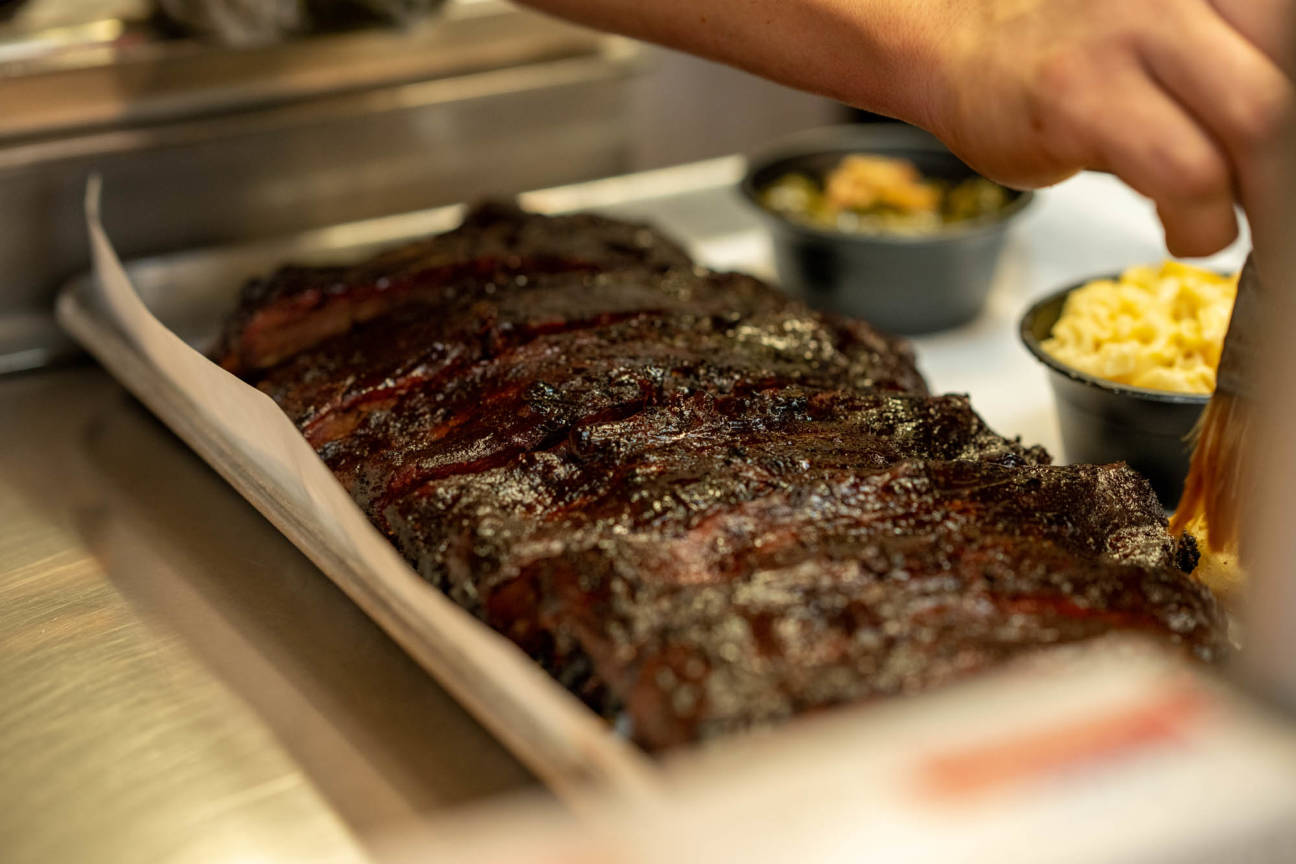
<p>When perfectly barbecued our ribs will have an intensely red <strong>“smoke ring”</strong> on the outermost surface of the meat followed by pink meat sometimes all the way to the bone. The meat of pork ribs should pull cleanly away from the bone with slight effort. Beef ribs will require somewhat more effort; something akin to eating prime rib, which is where in fact, the beef back rib comes from.</p>
<p>The color of the exterior of our ribs will vary from <strong>light brown</strong> to <strong>deep mahogany</strong> to <strong>tar black</strong>, depending on the smoke given off by a particular set of logs burning during the cook as well as the ambient barometric pressure and the relative humidity. These factors also control the intensity and depth of the wood smoke flavor.</p>
]]></content:encoded>
			<wfw:commentRss>http://buzandneds.com/newsletter/anatomy-of-buz-and-neds-pork-loin-back-rib/feed/</wfw:commentRss>
		<slash:comments>0</slash:comments>
		</item>
	</channel>
</rss>